
The Green Planet Dubai Guide: Tickets, Timings & Tips (2026)
Dubai’s Indoor Rainforest
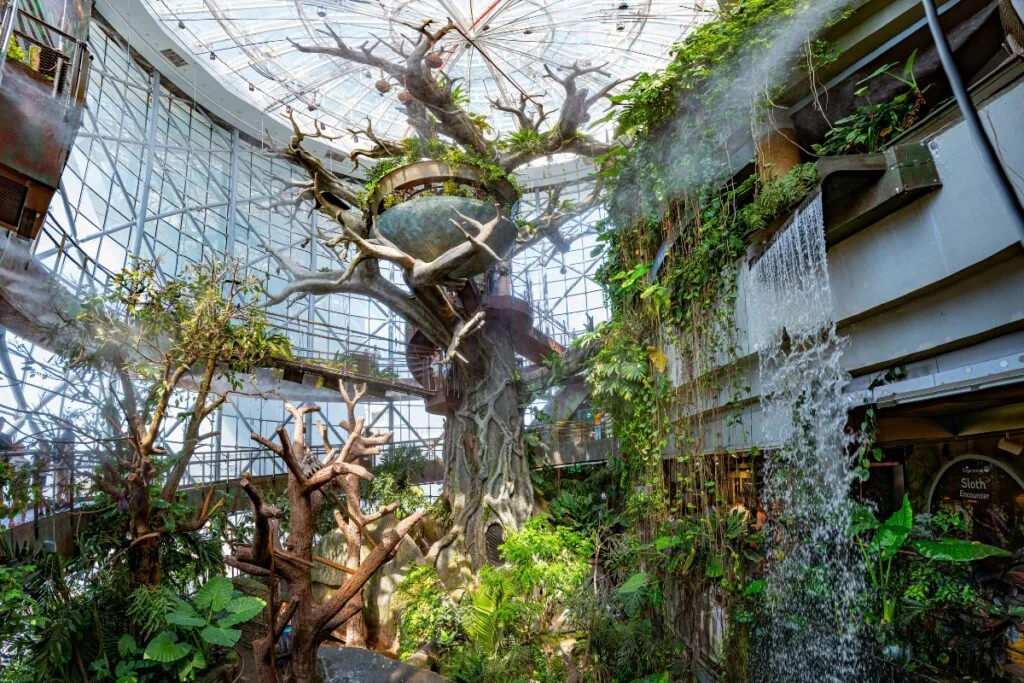
The Green Planet is the strangest building in Dubai to walk into: a glass bio-dome in City Walk that holds a full tropical rainforest, complete with a 25-metre tree at its centre, a waterfall, free-flying birds and more than 3,000 plants and animals. Step in from the Al Wasl Road heat and you are suddenly in warm, humid air under a canopy of leaves, with macaws overhead and a sloth somewhere above you if you look carefully enough. It opened in 2016 as the region’s first fully enclosed bio-dome, and it is still one of the few Dubai attractions that is genuinely different from everything else on a first-timer’s list — not a tower, not a mall, not a theme park. This guide covers the 2026 ticket prices, opening hours, the four rainforest levels, the animal encounters and the practical details that matter, so you can decide whether it is worth the ticket before you book.
One thing to know before anything else: this is a half-day visit, not a full day. Most visitors spend one and a half to three hours inside, and the ticket is not cheap for what is, at heart, one very good building. The honest verdict, from the guides checked for this article, is that it is excellent for families with children roughly aged 4 to 12, for anyone who loves animals, and for a summer or midday slot when the outdoor attractions are at their hottest — and best bought online, where the same day pass costs less than at the gate. Go in expecting a rainforest, not a zoo, and it delivers. Turn up expecting a full day out, and you will be back outside by lunchtime wondering what to do next — so pair it with City Walk, the Dubai Mall area or an evening at the fountain, and it becomes a strong half-day.
The Green Planet Tickets: Prices for 2026
The price gap is the thing most visitors miss: the same day pass costs less online than at the gate. Figures below come from guides checked 17 November 2026 against the official booking flow, and they agree on the headline numbers — but the child age band is reported differently by different sources, so confirm the band for your children at checkout before you pay:
- Day Pass, adult (11 and over) — AED 175 at the gate, AED 155 online: the standard ticket, one visit, all four levels included. The online price is the one to aim for; the gate price is the most you should pay.
- Day Pass, junior (2 to 10) — AED 150 at the gate, AED 135 online: the child ticket. Some guides list the junior band as ages 3 to 10 instead of 2 to 10 — the price is the same either way, but check which band your child falls in when you book.
- Infants — free: most guides say under 2s go free; a few say under 3s. Either way, the youngest children are free — bring proof of age if your child is near the boundary, because staff can ask.
- Premium Pass — AED 215 per person: the day pass plus a lizard encounter, fish feeding, a lanyard and a drink. Worth it only if you actually want the encounter — the standard pass already covers the whole dome.
- VIP Pass — AED 349 per person (minimum two tickets): a guided tour, a dessert and a souvenir photo, plus the extras. The guided tour is the real value here: a guide who knows where the sloth is sleeping is worth more than the photo.
- Kids Go Free promotion — reported, limited time: the operator has advertised one qualifying child free with each eligible paying adult. It is a promotion, not a permanent price, so check whether it is live for your date before counting on it.
- Annual Pass — AED 495, reported: listed by one guide as the yearly option. Only worth it if you will visit three or more times in a year — for most tourists, the day pass is the right ticket.
Tickets are widely reported as non-refundable, non-transferable and non-exchangeable, so pick your date with care and do not buy for a day you are not sure about. Book online in advance for the lower price and to skip the ticket queue; weekend and school-holiday slots sell out first, and the online sales cut-off is earlier than the gate cut-off (see hours below).
Opening Hours (2026)
The hours are simple and the same every day — which is part of the appeal. There is no weekday/weekend split to remember:
- Open daily: 10:00 AM to 6:00 PM, every day of the week.
- Last ticket at the gate: 5:00 PM. Arrive by 4:00 PM at the latest to get a full visit — the dome takes at least ninety minutes to do properly.
- Online sales stop earlier: 3:30 PM for same-day tickets, according to third-party summaries of the booking flow. If you are booking on the day, do it before mid-afternoon or buy at the gate instead.
Hours can shift during Ramadan and on public holidays, so check the hours shown for your booking date on the official site before you travel. The dome is indoors and air-conditioned all year, so the season does not change the experience inside — but it changes everything around it: in summer, the Green Planet is one of the best midday escapes in the city, and it is busier at midday than visitors expect.
The best time to go is the 10:00 AM opening on a weekday. The animals are most active in the morning, the light through the glass roof is at its best, and the school groups have not arrived yet. By midday on a Friday or Saturday the walkways are crowded, the popular encounters are booked out, and the quiet corners of the dome are harder to find. If you can only visit on a weekend, book the first slot of the day.
Inside the Dome: The Four Levels
The visit is a descent: you start at the top, in the canopy, and work your way down through the rainforest layers to the forest floor. Each level has a different character, and the animals change as you go down:
The Canopy: the top of the dome, at the crown of the 25-metre tree. This is where the free-flying birds are — macaws, toucans and smaller birds that move between the branches above your head. It is the brightest level, the best for photographs, and the place to spend time at the start, before the crowds reach it. Look up, not just ahead: most of the birds are above eye level.
The Midstory: the middle layer, where the walkways wind through dense planting and the animals are closer to hand. This is the best level for children: the animals are at child height, the walkways are wide enough for a pushchair, and the encounters happen here. Take it slowly — the animals here are easy to walk past if you hurry.
The Forest Floor: the ground level, darker and damper, where the big insects, snakes, frogs and the giant anteater live. The sloth is the animal everyone asks about, and it is usually here or in the midstory, asleep in a tree — ask a member of staff where it is today, because it moves, and the staff know. The forest floor is also where the dome feels most like a real rainforest: warm, humid and close.
The Flooded Rainforest: the aquarium level, where the rainforest meets the water. Piranhas, arapaima and other river fish swim in tanks built into the dome, and it is the coolest, quietest part of the visit — a good place to finish, and to sit down for a few minutes before heading back out into Dubai.
Between the levels there are smaller exhibits, a reptile area and the animal encounter stations. The whole dome is kept at roughly 24 to 27 degrees with about 75 percent humidity — warm and sticky by design, so wear light clothes and leave the jacket outside. The walkways are step-free for most of the route, and the descent is gentle, but the dome is a working rainforest: the floors can be damp, and the paths are narrower than a mall corridor.
The Animals Worth Finding
With more than 3,000 plants and animals, the choice is not whether there is enough to see, but which animals are worth your time. In order:
The sloth: the dome’s most famous resident, and the hardest to find. It sleeps for most of the day in a tree, so ask staff where it is before you start — a two-minute question saves twenty minutes of searching. The sloth encounter, when available, is the one paid extra most visitors remember.
The macaws: the blue hyacinth macaws and their smaller cousins fly free in the canopy and are the most photographed animals in the dome. They are loud, bright and usually visible from the top walkway — the best photographs are in the morning, when the light comes through the glass roof.
The lemurs: quick, curious and usually in the midstory. They move fast, so children love them and photographers find them frustrating — watch for a minute rather than chasing them along the walkway.
The giant anteater: the forest floor’s biggest animal, and the one most visitors walk past without noticing. It is slow, low to the ground and easy to miss behind the planting — look for the long snout and the sweeping tail.
The snakes, frogs and insects: the forest floor tanks hold the animals that make children stop and stare — tree pythons, poison dart frogs and the leaf-cutter ants, whose trail runs through the dome in a clear tube. The ant trail is the quiet star of the visit: follow it for a minute and you will see the whole colony at work.
Do not expect a big-cat or elephant experience: this is a rainforest bio-dome, not a safari park. The animals are small, the enclosures are planted rather than barred, and the pleasure is in finding them rather than in seeing them lined up. Families who go in with that expectation love it; visitors expecting a zoo leave disappointed.
Animal Encounters: Worth the Extra?
The encounters are the paid extras, and they are the one place where spending more genuinely changes the day:
- Lizard encounter (included in Premium): a short, hands-on session with one of the dome’s lizards. Good for children who want to touch something rather than just look — short, gentle and well run.
- Fish feeding (included in Premium): feeding time at the Flooded Rainforest tanks. Worth it if you are already buying Premium; not worth buying Premium for on its own.
- Sloth encounter (separate booking): the one encounter to book in advance if it is available on your date. It sells out, it is the animal everyone wants to meet, and it is the only encounter that feels unmissable.
- VIP guided tour (VIP Pass): the best value of the upgrades if you want the full story — a guide who knows where each animal is, what it is doing and why it matters. For a first visit, the guided tour is worth more than the Premium extras.
Book encounters when you book the ticket, not at the gate: the popular ones sell out by midday, especially on weekends. If the encounter you wanted is sold out, ask at the desk anyway — cancellations happen, and the staff will tell you honestly whether it is worth waiting.
How to Get to The Green Planet
The Green Planet sits inside City Walk, in the Al Wasl district — between Downtown Dubai and Jumeirah, and close enough to the Dubai Mall area to pair the two in one day. There is no Metro station at the door, so plan your transport:
- Taxi or ride-hailing: the simplest option. From Downtown Dubai or Dubai Marina the drive is roughly 10 to 20 minutes in normal traffic, and taxis are easy to find at City Walk when you leave.
- Metro plus taxi: the nearest Red Line stations are Business Bay and Burj Khalifa / Dubai Mall, both a short taxi ride from City Walk. Do not plan to walk from the Metro — it is further than it looks on the map, and the walk is along busy roads with little shade.
- Bus: RTA buses serve City Walk from the surrounding districts. Check the RTA app on the morning of your visit, because bus routes and frequencies change, and allow extra time — the bus is considerably slower than a taxi.
- Driving: City Walk has parking, and the drive from Downtown is straightforward. If you are driving, the Green Planet pairs well with an evening at the Dubai Mall and the fountain — the dome from 10:00 AM, the mall and the fountain from late afternoon.
Allow a full hour to get there from central Dubai by public transport, and do not plan a tight connection afterwards. City Walk itself is worth an hour on its own: open-air streets, restaurants and the murals that line the walkways, all at a slower pace than the mall.
Best Time to Visit and How Long to Spend
November to March is the best season — not because of the weather inside, which is air-conditioned all year, but because the whole City Walk area is pleasant to walk around in, so the dome plus the streets around it make a full half-day. In summer, the Green Planet is one of the few attractions that runs at full strength in the middle of the day, which makes it busier at midday on summer weekends than visitors expect — but it is also one of the best places in the city to be at 1:00 PM in August.
The best day is a weekday, Tuesday to Thursday, arriving at the 10:00 AM opening. Weekends, public holidays and school breaks are the busiest, and the encounter slots go first. If you can only visit on a Saturday, book online in advance, arrive at opening, and book the sloth encounter at the same time as the ticket.
Plan for one and a half to three hours inside. A good shape for the day is: the canopy first, from 10:00 AM, while the birds are active and the light is good; the midstory next, slowly, with the encounters; the forest floor and the Flooded Rainforest last, when the crowds have thinned; then lunch or coffee in City Walk. Families with small children should plan for about two hours centred on the midstory and the encounters, with a break in the middle — the humidity tires small children faster than adults expect.
Tips Before You Go
Buy the ticket online in advance — the discount over the gate price is real, and the official AED 175 is the most you should pay for a standard adult ticket. Pick a weekday if you can, and arrive at the 10:00 AM opening rather than drifting in at 4:00 PM, when the last ticket is at 5:00 PM and you have paid the full day price for an hour inside. Ask staff where the sloth is before you start, because it moves and they know. Wear light clothes — the dome is warm and humid by design — and bring water, because the humidity is dehydrating even though you are indoors. Take the camera, but leave the flash off: it disturbs the animals and it does not help in the canopy light. And if you are pairing the visit with the Dubai Mall, buy that area’s tickets separately: the Green Planet is a City Walk ticket, not a mall ticket, and the two are a short taxi ride apart.
Packages That Help With This
The Green Planet is a half-day ticket in City Walk, so it fits best inside a trip where the rest is already sorted. Wonders Gate Tours can arrange the pieces around your visit:
- UAE Visit Visa — 30-day and 60-day visit visas, with extension options.
- Global Tours — holiday packages that can include Dubai’s attractions, hotels and transfers.
- Desert Safari — the classic Dubai evening: dune bashing, camel ride, BBQ dinner and shows, a good contrast to a morning indoors.
- Global Visas — visa services for more than 20 countries, if your trip continues beyond the UAE.
The Green Planet FAQs
How much are The Green Planet Dubai tickets?
The standard day pass is AED 175 for adults aged 11 and over at the gate, or AED 155 online; juniors aged 2 to 10 are AED 150 at the gate or AED 135 online, and infants under 2 go free. Some guides list the junior band as ages 3 to 10 and free entry as under 3 — the price is the same, but confirm the band for your children at checkout. The Premium Pass is AED 215 and the VIP Pass is AED 349 per person with a two-ticket minimum. Tickets are widely reported as non-refundable, so confirm the total for your exact date before you pay.
What are The Green Planet opening hours?
Daily, 10:00 AM to 6:00 PM, every day of the week. The last ticket at the gate is sold at 5:00 PM, and online sales for the same day stop at 3:30 PM — arrive by 4:00 PM at the latest for a full visit. Hours can shift during Ramadan and on public holidays, so check the hours for your date on the official site.
Is The Green Planet Dubai worth it?
For families with children roughly aged 4 to 12, for animal lovers, and for a summer midday slot when the outdoor attractions are at their hottest, yes — especially at the online price. For visitors expecting a full-day zoo or a safari park, no: it is one very good building, best as a half-day paired with City Walk or the Dubai Mall area. Arrive at the 10:00 AM opening on a weekday and it is a strong half-day; turn up at 4:00 PM on a Saturday at the gate price and it is the worst value in the city.
How long do you need at The Green Planet?
One and a half to three hours for most visitors. Two hours is enough for the four levels at a comfortable pace; three hours allows for the encounters, a slow look at the forest floor tanks and a break in between. Families with small children should plan for about two hours, with a break — the warm, humid air tires small children faster than adults expect.
How do I get to The Green Planet by public transport?
There is no Metro station at the door. The nearest Red Line stations are Business Bay and Burj Khalifa / Dubai Mall, both a short taxi ride from City Walk — do not plan to walk from the Metro. The simplest route is a taxi or ride-hailing car from Downtown Dubai or Dubai Marina, about 10 to 20 minutes. RTA buses serve City Walk, but check the RTA app on the morning of your visit and allow a full hour.
Is The Green Planet good for small children?
Yes, with the right expectations. Children under 2 go free, and the midstory level — animals at child height, wide walkways, the encounters — is built for them. But the dome is warm and humid, the visit is mostly looking rather than riding, and small children tire quickly in the heat inside. Plan for about two hours, take a break in the middle, and bring water. The sloth encounter and the lizard encounter are the parts children remember most.
Planning a trip to Dubai? Message Wonders Gate Tours on WhatsApp at +971 50 235 1314 for visa help, holiday packages and desert safari bookings — and ask about adding a Green Planet morning to your itinerary.
Experience the Magic of Arabian Desert Safari
Embark on an unforgettable journey through the golden dunes of the Arabian Desert. From thrilling dune bashing to mesmerizing sunset views and traditional Bedouin experiences, create memories that will last a lifetime.

Recent Posts

LEGOLAND Dubai Guide: Tickets, Timings & Tips (2026)
Dubai Garden Glow Guide: Tickets, Timings & Tips (2026)

Dubai Butterfly Garden Guide: Tickets, Timings & Tips (2026)
All Categories
- Azerbaijan Tours
- Business & Work Opportunities in Dubai
- Camping
- City Tours
- Desert Safari
- Dubai Adventure & Luxury Experiences
- Dubai Shopping & Entertainment
- Dubai Tourist Attractions & Activities
- Dubai Travel Guides
- Dubai Visit Visa & Travel Tips
- Evening Desert Safari
- Festivals & Events in Dubai
- Thailand Visa
- Travel Guide
- UAE Travel Beyond Dubai
- Uncategorized
- Visa